
Supplier Relationship Management Market Comparison
Suppeco, State of Flux, Kodiak Hub and HICX compared
“Supplier relationship management” has become a category label wide enough to cover tools that have almost nothing in common. A master data platform, a supplier scorecard engine, a consultancy methodology with software attached, and an operational relationship layer all get filed under the same three letters. Buyers then compare them as though they were substitutes, which they are not. The useful question is not which SRM tool is best. It is which problem you are trying to solve, because each of these products is built around a different one.
This piece looks at three of the more credible supplier-focused specialists, State of Flux, Kodiak Hub and HICX, and where Suppeco sits relative to them. The large source-to-pay suites, Coupa, SAP Ariba and Jaggaer, belong in a separate conversation, which we will take on its own terms.
The line that separates them: where value leaks
Most supplier tools do their best work on the clean, structured, periodic view of a supplier: the record, the score, the assessment cycle. That view matters. It is also not where most value is made or lost. Value tends to leak after the contract is signed, in the operational space between the formal reviews, in the unstructured day-to-day of how two organisations work together. That layer is the hardest to systematise, which is why so few tools try. It is also the layer that decides whether a relationship appreciates or quietly depreciates. Keep that distinction in mind, because it is the line that separates these four products.
HICX: the supplier data foundation
HICX is, by its own description, only for supplier data. It is a supplier master data management platform that sits above your transactional systems and produces a single governed record for every supplier, unified across multiple ERPs and procurement suites. It is built for the Global 2000 and for complex, regulated industries where supplier data is scattered across dozens of systems and weighed down by local requirements.
That is a serious problem, and HICX solves a real one. If your supplier data is fragmented and untrustworthy, nothing built on top of it will hold. But a golden record is a foundation, not a relationship. HICX makes the data dependable. It is not trying to be the place where the working relationship is managed day to day. It is the layer beneath that.
Kodiak Hub: the assessment and scorecard engine
Kodiak Hub is a modular, cloud SRM platform with real strength in supplier assessment: onboarding, segmentation, 360-degree scorecards, risk monitoring, and a strong ESG and sustainability line covering CSRD, CSDDD and carbon reporting. It is quick to deploy, pleasant to use, and well suited to procurement teams that want to measure and rank their supply base on structured data.
Its centre of gravity is measurement. Assessments, ratings and scorecards are, by design, periodic and snapshot-based: you evaluate, you score, you review, you repeat. That is valuable, and for many teams it is a large step up from spreadsheets. The limit is the one that applies to any assessment model. The score tells you where a supplier stood at the last measurement. It says less about the continuous operational relationship in between, which is where performance is delivered or lost.
State of Flux: the methodology and the discipline
State of Flux comes at SRM from the consultancy side, and it is one of the more serious names there. It brings two decades of SRM practice, a well-known annual Global SRM Research programme, structured training, and a software platform, SupplierBase, to house the discipline. The strength here is human: segmentation, governance models, joint business planning, and capability building inside the procurement team.
If your gap is discipline, that your people and process are not yet doing SRM properly, State of Flux has a real answer, and the tool follows the method. The distinction is exactly that ordering. It is methodology-first, with the platform acting as the system of record for a programme the consultancy helps you stand up. That is a different proposition from a product built, from the ground up, to run the operational relationship itself.
Suppeco: the operational relationship layer
Suppeco starts where the others stop: the post-signature operational relationship. It is a native-cloud platform built around continuous collaboration between buyer and supplier rather than periodic assessment of them. The design premise is that a supplier relationship is a depreciating asset unless it is actively managed, and that most of the signal worth managing lives in the unstructured operational layer, the day-to-day exchange that never reaches a scorecard or a master record.
So Suppeco is built to capture and act on that layer: real-time collaborative working between the two sides, actionables and insights drawn from the operational exchange, and relationship data treated as a live managed asset rather than a record to be kept clean or a score to be refreshed each quarter. It assumes the master data and the assessments exist, or can be integrated, and concerns itself with the part that decides whether the relationship delivers: how the two organisations work together once the contract is live.
Where each one sits
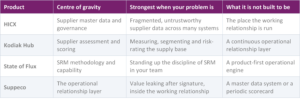
Choosing between them, or not
These are not four answers to one question, and in a mature supply base they are not necessarily mutually exclusive. A large enterprise could reasonably run governed supplier data, a scoring model, an SRM training programme and an operational relationship platform at the same time, because they address different layers. The honest way to choose is to name your problem first.
If you cannot trust your supplier data, start with the data layer. If you cannot measure or segment your suppliers, start with assessment. If your team does not yet practise SRM as a discipline, start with methodology. And if the problem is the one that shows up after everything is signed and scored, the value that quietly leaks out of the working relationship, that is the problem Suppeco was built for.
A separate comparison looks at Suppeco against the source-to-pay suites, Coupa, SAP Ariba and Jaggaer, which sit in a different category again: transactional spines where SRM is one module among many.